Get to know about our Department
The origins of organised community development in Ghana date back to 1948, when a Social Development Branch was established, and a pioneering experiment in mass education was launched by a mobile team in Trans-Volta Togoland, at Peki Blengo. That pilot demonstrated that literacy, civic awareness, and community self-help could be advanced together at the decentralised level.
In 1951, the Ministry of Education and Social Welfare prepared a plan for Mass Literacy and Mass Education. The Plan was subsequently approved by the Legislative Assembly and became the foundation of a nationwide programme of adult literacy, community animation, and rural improvement. In 1952, the then Department of Social Welfare and Community Development was reorganised, and Community Development emerged as a distinct departmental function dedicated to mobilising communities for their own development.
From those beginnings, the Department has remained a frontline institution of the state, working with rural and peri-urban communities to improve living standards, build local capacity, and strengthen participatory development. That heritage now underpins the Department’s Refocusing Agenda: a return to its core mandate of Community Education and Sensitisation, Community Mobilisation and Extension, and Skills Development and Livelihoods, among others, delivered through the National Strategies for Community Transformation.
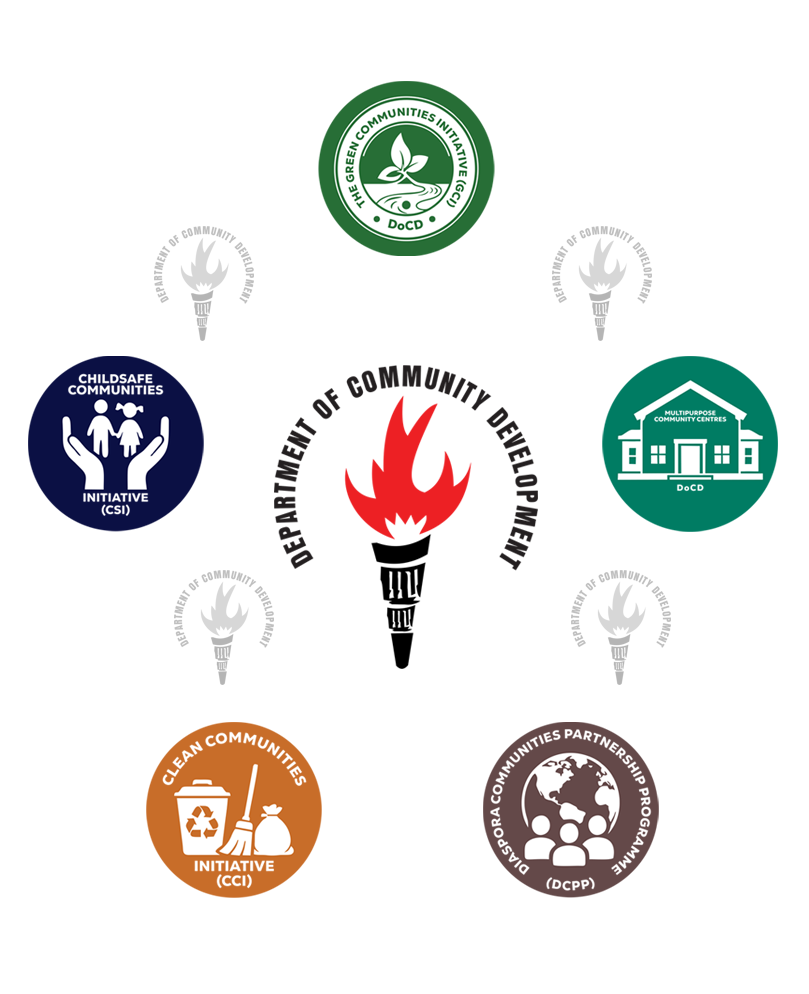
To promote and ensure improvement in the living standard of people in the rural areas and disadvantaged sections of the urban communities through their initiatives and their active participation in a decentralized system of administration.
Excellent Community Development practices which are voluntary and healthy interdependent that will be mutually beneficial with shared responsibilities to enhance the living standard of both urban and rural communities.